The best AI marketing agents

The 7 best AI marketing agents in 2026

TL;DRSuperscale is the only AI marketing agent in 2026 that runs the full organic-/paid-creative loop end to end: research, creative, publishing and iteration. Plans start at $49/mo, which makes it the only agent on this list priced for both founders & growth teams and enterprises. If you want an autonomous creative marketer you can actually afford, start here.
superscale-vs-acads

How we built this ranking

How we built this ranking

Most "best AI marketing agent" lists are really lists of AI generators. This one isn't. A platform only earns a spot below if it plans and executes across multiple steps, writes into real marketing systems (ad platforms, CRMs, analytics) rather than handing you a file, and carries context forward from one run to the next. For the full anatomy of what qualifies and the four capabilities the category is built on, start with our primer: What is an AI marketing agent?

Names you won't see in the ranking, Arcads, AdCreative.ai, Pencil, HeyGen, Synthesia, Creatify, ReelFarm, are excluded for the same reason: they produce an asset on demand and stop. Great tools, but one task each, not agents.


The seven that did make it split across different slices of the marketing job. Only Superscale and Omneky actually generate paid ad creative. Agentforce and HubSpot Breeze run CRM and lifecycle. Albert.ai is a media buyer. Jasper is content. Copy.ai is GTM workflow. Rank them against your actual bottleneck, not a generic leaderboard.


The 7 best AI marketing agents in 2026

The 7 best AI marketing agents in 2026

Rank

Agent

What it does

Entry Price

1

Superscale AI

Runs the full paid creative loop: research, generate, publish, iterate

$49/mo

2

Salesforce Agentforce

Orchestrates marketing + sales + service agents across Customer 360

$2/conversation (enterprise)

3

HubSpot Breeze Agents

Content, Social, Prospecting and Customer agents inside HubSpot

Free tier + Pro from $90/mo

4

Jasper

Agentic content workflows with brand IQ and custom agent builder

$69/mo

5

Omneky

Autonomous ad creative generation and multi-channel performance testing

Custom (enterprise)

6

Albert.ai (by Zoomd)

Autonomous paid media buyer across Google, Meta and programmatic

$2,000/mo

7

Copy.ai

GTM AI workflows and sales + marketing agent chaining

$49/mo

7. Copy.ai – The GTM workflow agent

Best for: revenue teams (marketing + sales) who want to chain AI tasks into repeatable agent workflows across the funnel.


Copy.ai pivoted hard from AI copywriter to GTM AI platform. The product is now a workflow builder that lets you compose agents: a prospect-research agent feeds a personalization agent, which feeds an outbound agent, which reports back into a CRM agent. It covers both sides of the marketing-sales seam in a way single-purpose tools cannot.


Copy.ai shines where the job is "structured, repeatable GTM motion." It is less strong for creative production (no video, limited visual ads) and less autonomous than Agentforce or Superscale (you build the workflows; Copy.ai runs them).


What it autonomously handles: prospect research, outbound personalization, content repurposing, lifecycle touchpoints.


Limitation: you design the workflow. Limited creative and visual capabilities.


Right for you if: you want to productize repeatable GTM motions and have the operator time to build them.

Best for: revenue teams (marketing + sales) who want to chain AI tasks into repeatable agent workflows across the funnel.


Copy.ai pivoted hard from AI copywriter to GTM AI platform. The product is now a workflow builder that lets you compose agents: a prospect-research agent feeds a personalization agent, which feeds an outbound agent, which reports back into a CRM agent. It covers both sides of the marketing-sales seam in a way single-purpose tools cannot.


Copy.ai shines where the job is "structured, repeatable GTM motion." It is less strong for creative production (no video, limited visual ads) and less autonomous than Agentforce or Superscale (you build the workflows; Copy.ai runs them).


What it autonomously handles: prospect research, outbound personalization, content repurposing, lifecycle touchpoints.


Limitation: you design the workflow. Limited creative and visual capabilities.


Right for you if: you want to productize repeatable GTM motions and have the operator time to build them.

6. Albert.ai – The autonomous media-buying agent

Best for: enterprise brands running large paid search and social campaigns who want a media buyer agent handling bid, budget and audience work with minimal oversight.


Albert (now Albert by Zoomd) is the media-buying agent. It launches, pauses, scales and restructures campaigns across paid search, Meta and programmatic display. No manual bid adjustments. No manual creative swaps. Albert analyzes performance, reallocates budget toward highest-LTV segments, and surfaces creative hypotheses for humans to approve. Albert's published case studies cite ROAS lifts in the 30-50% range.


Albert is a pure media-buying agent, not a creative agent. You still need a creative engine (Superscale, Omneky) producing the ads Albert will spend against. Pricing starts at $2,000/month for accounts spending $100k-$250k monthly, and rises with spend.


What it autonomously handles: budget allocation, bid management, audience creation and testing, cross-channel reallocation.


Limitation: creative production is out of scope. Enterprise-only pricing.


Right for you if: you have meaningful paid spend, a working creative engine, and want to take the media-buying job off human shoulders.

Best for: enterprise brands running large paid search and social campaigns who want a media buyer agent handling bid, budget and audience work with minimal oversight.


Albert (now Albert by Zoomd) is the media-buying agent. It launches, pauses, scales and restructures campaigns across paid search, Meta and programmatic display. No manual bid adjustments. No manual creative swaps. Albert analyzes performance, reallocates budget toward highest-LTV segments, and surfaces creative hypotheses for humans to approve. Albert's published case studies cite ROAS lifts in the 30-50% range.


Albert is a pure media-buying agent, not a creative agent. You still need a creative engine (Superscale, Omneky) producing the ads Albert will spend against. Pricing starts at $2,000/month for accounts spending $100k-$250k monthly, and rises with spend.


What it autonomously handles: budget allocation, bid management, audience creation and testing, cross-channel reallocation.


Limitation: creative production is out of scope. Enterprise-only pricing.


Right for you if: you have meaningful paid spend, a working creative engine, and want to take the media-buying job off human shoulders.

5. Omneky – The autonomous ad creative agent

Best for: enterprise DTC and performance teams who want an agent generating, launching and optimizing ad creative across Meta, Google, TikTok, LinkedIn and Reddit.


Omneky is the closest competitor to Superscale on positioning. It generates AI ad creative (image, video, UGC), launches variants into paid channels, reads performance in real time, and adjusts creative mix based on what is working. It actually tests on its own.


Two real differences from Superscale. First, Omneky is enterprise-gated with custom pricing typically in the low four figures and up. Second, it assumes you already have substantial ad-account history to feed the model; sub-$50k monthly spenders rarely get full value. If you meet both bars, Omneky is a serious platform.


What it autonomously handles: multi-channel ad creative generation, variant launch, performance-driven creative rotation.


Limitation: enterprise pricing, managed onboarding, heavier lift than Superscale for smaller teams.


Right for you if: you run $100k+/month on paid and want a managed creative agent partner.

Best for: enterprise DTC and performance teams who want an agent generating, launching and optimizing ad creative across Meta, Google, TikTok, LinkedIn and Reddit.


Omneky is the closest competitor to Superscale on positioning. It generates AI ad creative (image, video, UGC), launches variants into paid channels, reads performance in real time, and adjusts creative mix based on what is working. It actually tests on its own.


Two real differences from Superscale. First, Omneky is enterprise-gated with custom pricing typically in the low four figures and up. Second, it assumes you already have substantial ad-account history to feed the model; sub-$50k monthly spenders rarely get full value. If you meet both bars, Omneky is a serious platform.


What it autonomously handles: multi-channel ad creative generation, variant launch, performance-driven creative rotation.


Limitation: enterprise pricing, managed onboarding, heavier lift than Superscale for smaller teams.


Right for you if: you run $100k+/month on paid and want a managed creative agent partner.

4. Jasper – The agentic content workspace

Best for: brand and content marketing teams at mid-market and enterprise who want agents enforcing a strict brand voice across long-form content, email and social.


Jasper has transitioned from an AI copywriter to what it now calls an Agentic Marketing Platform.

The centerpiece is Jasper Studio: a builder where marketing teams create custom agents with persistent brand context, task chains, and knowledge bases. More than 5,800 custom apps have been built on Studio as of early 2026. The Brand IQ layer ensures every agent stays on voice.


Where Jasper actually acts like an agent: it runs multi-step content workflows (turn a whitepaper into a blog, LinkedIn thread, email and nurture sequence) without human handholding at each step. Where it is weaker: it is still text-first. Video, ad creative and media buying are outside its scope.


What it autonomously handles: long-form content, repurposing, brand-voice enforcement, campaign copy across channels.


Limitation: text and static content only. No video production, no ad publishing, no media buying.


Right for you if: your content operation spans blog, email, social and long-form, and voice consistency is critical.

Best for: brand and content marketing teams at mid-market and enterprise who want agents enforcing a strict brand voice across long-form content, email and social.


Jasper has transitioned from an AI copywriter to what it now calls an Agentic Marketing Platform.

The centerpiece is Jasper Studio: a builder where marketing teams create custom agents with persistent brand context, task chains, and knowledge bases. More than 5,800 custom apps have been built on Studio as of early 2026. The Brand IQ layer ensures every agent stays on voice.


Where Jasper actually acts like an agent: it runs multi-step content workflows (turn a whitepaper into a blog, LinkedIn thread, email and nurture sequence) without human handholding at each step. Where it is weaker: it is still text-first. Video, ad creative and media buying are outside its scope.


What it autonomously handles: long-form content, repurposing, brand-voice enforcement, campaign copy across channels.


Limitation: text and static content only. No video production, no ad publishing, no media buying.


Right for you if: your content operation spans blog, email, social and long-form, and voice consistency is critical.

3. HubSpot Breeze Agents – The mid-market agent suite

Best for: SMBs and mid-market teams on HubSpot that want agents shipped into their existing hubs without a separate procurement.


Important: Breeze does not generate paid ad creative. Content Agent writes blog posts, landing pages and case studies. Social Agent drafts organic social posts, not paid ads. Neither one produces video or performance creative for Meta, TikTok or Google. Pair Breeze with a creative agent like Superscale if paid is the bottleneck.


HubSpot shipped Breeze as a suite of agents embedded across Marketing, Sales, Service, Content and Operations Hubs. Four are particularly relevant to marketing: Content Agent (generates blog posts, landing pages, case studies), Social Agent (drafts and schedules social posts grounded in CRM context), Prospecting Agent (runs outbound research and sequencing), and Customer Agent (handles inbound support that feeds back into marketing signal).


The agent philosophy is different from Salesforce. Breeze is accessible by default. Agents ship on the free CRM tier with paid upgrades, 279K+ customers are already using them, and setup is measured in hours, not months. The trade-off is ceiling: Breeze agents are less customizable than Agentforce and more tied to HubSpot's own surface.


What it autonomously handles: content drafting and publishing, social scheduling, prospect research, lifecycle nurturing.

Limitation: tightly bound to the HubSpot ecosystem. If your stack is elsewhere, Breeze is harder to justify.


Right for you if: HubSpot is already your CRM and you want AI agents inside the same workspace.

Best for: SMBs and mid-market teams on HubSpot that want agents shipped into their existing hubs without a separate procurement.


Important: Breeze does not generate paid ad creative. Content Agent writes blog posts, landing pages and case studies. Social Agent drafts organic social posts, not paid ads. Neither one produces video or performance creative for Meta, TikTok or Google. Pair Breeze with a creative agent like Superscale if paid is the bottleneck.


HubSpot shipped Breeze as a suite of agents embedded across Marketing, Sales, Service, Content and Operations Hubs. Four are particularly relevant to marketing: Content Agent (generates blog posts, landing pages, case studies), Social Agent (drafts and schedules social posts grounded in CRM context), Prospecting Agent (runs outbound research and sequencing), and Customer Agent (handles inbound support that feeds back into marketing signal).


The agent philosophy is different from Salesforce. Breeze is accessible by default. Agents ship on the free CRM tier with paid upgrades, 279K+ customers are already using them, and setup is measured in hours, not months. The trade-off is ceiling: Breeze agents are less customizable than Agentforce and more tied to HubSpot's own surface.


What it autonomously handles: content drafting and publishing, social scheduling, prospect research, lifecycle nurturing.

Limitation: tightly bound to the HubSpot ecosystem. If your stack is elsewhere, Breeze is harder to justify.


Right for you if: HubSpot is already your CRM and you want AI agents inside the same workspace.

2. Salesforce Agentforce – The enterprise agent platform

Best for: enterprise marketing teams already on Salesforce Marketing Cloud who want agents orchestrated across sales, service and marketing.


Important: Agentforce does not generate paid ad creative. It writes email, SMS and landing page copy, personalizes campaign content and runs customer journeys. There is no video engine and no performance-ad engine. If your bottleneck is ads, pair Agentforce with a creative agent like Superscale.


Agentforce is Salesforce's answer to the agent era. It sits on top of the Einstein AI layer and Data Cloud, and it lets enterprises build custom agents that act across the Customer 360 data model. Marketing-facing use cases include journey orchestration, segmentation, content generation and campaign activation, all grounded in Salesforce CRM data.

Agentforce hit $540M ARR inside its first 18 months of general availability, which tells you who it is for: Fortune 2000 companies that already run Salesforce and have the budget for custom agent builds. It is powerful but heavy. Most customers need an AI architect or a certified partner to get full value.


What it autonomously handles: customer journey orchestration, data-grounded content generation, lead prioritization, service + marketing handoff.


Limitation: requires existing Salesforce infrastructure, typically months of setup, and priced per conversation (around $2 per conversation in the standard agent pricing model).


Right for you if: you are already a Salesforce customer at enterprise scale and you want marketing agents that share a single data spine with sales and service.

Best for: enterprise marketing teams already on Salesforce Marketing Cloud who want agents orchestrated across sales, service and marketing.


Important: Agentforce does not generate paid ad creative. It writes email, SMS and landing page copy, personalizes campaign content and runs customer journeys. There is no video engine and no performance-ad engine. If your bottleneck is ads, pair Agentforce with a creative agent like Superscale.


Agentforce is Salesforce's answer to the agent era. It sits on top of the Einstein AI layer and Data Cloud, and it lets enterprises build custom agents that act across the Customer 360 data model. Marketing-facing use cases include journey orchestration, segmentation, content generation and campaign activation, all grounded in Salesforce CRM data.

Agentforce hit $540M ARR inside its first 18 months of general availability, which tells you who it is for: Fortune 2000 companies that already run Salesforce and have the budget for custom agent builds. It is powerful but heavy. Most customers need an AI architect or a certified partner to get full value.


What it autonomously handles: customer journey orchestration, data-grounded content generation, lead prioritization, service + marketing handoff.


Limitation: requires existing Salesforce infrastructure, typically months of setup, and priced per conversation (around $2 per conversation in the standard agent pricing model).


Right for you if: you are already a Salesforce customer at enterprise scale and you want marketing agents that share a single data spine with sales and service.

1. Superscale – The full-stack marketing agent
Best for: founders, growth teams and agencies that want one agent running the brief-to-published loop for paid and organic creative.


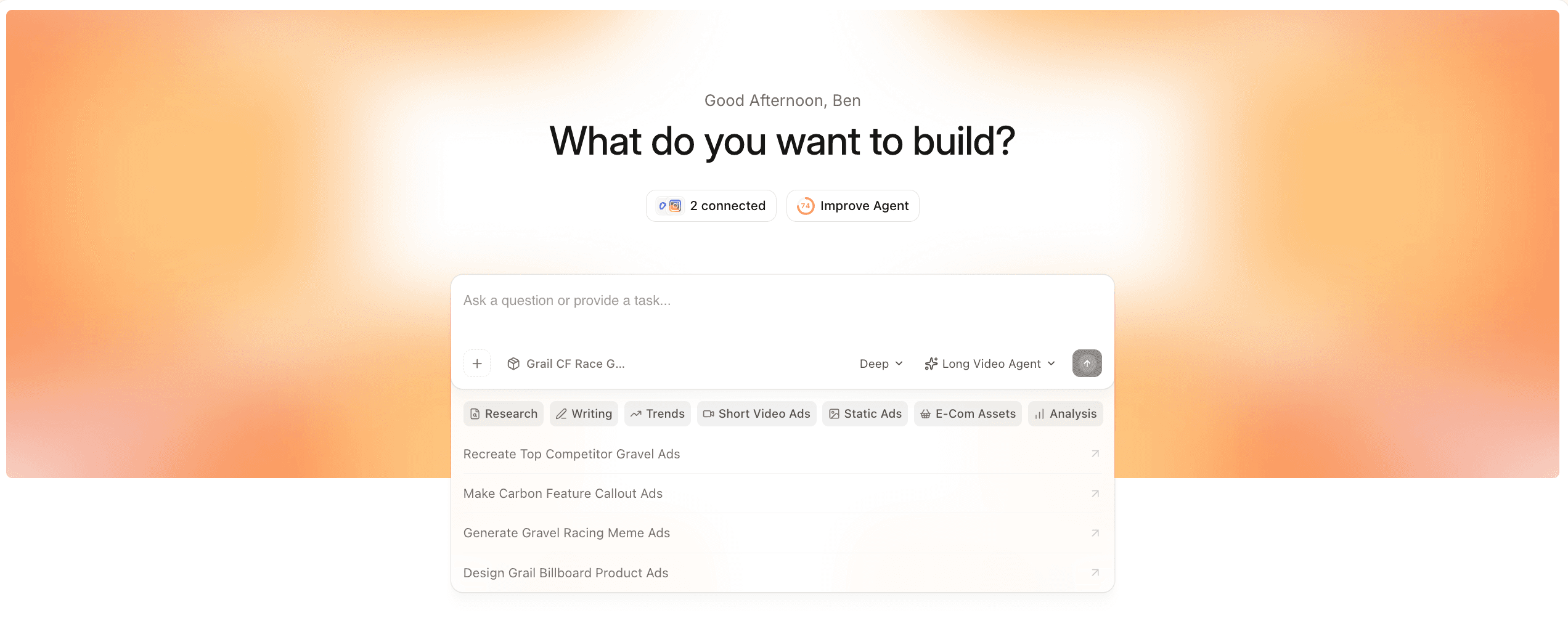
Superscale positions itself as the AI CMO for the 99%. Instead of orchestrating CRM workflows (Agentforce, HubSpot) or chaining text prompts (Copy.ai, Jasper), it owns the part of the marketing job most teams spend the most time on: making ads, shipping them, rotating what works.

You give it a brief. It researches what is winning in your category, writes scripts and copy, generates video and static variants, pushes them to Meta, TikTok, Instagram and Google, and iterates on the winners.


The pricing model is what actually changes how you operate.

Unlimited drafts, pay only when you export a final asset (around $1.90 per export). Every other agent on this list meters something: conversations (Agentforce), seats (Jasper, HubSpot), or ad spend (Albert, Omneky). Superscale removes the "should I test this or save credits" question. You just test.


What it autonomously handles: competitor research, script and copy writing, video and static generation, multi-language adaptation, publishing, A/B variant creation.


Limitation: Superscale is focused on paid and organic creative. It does not orchestrate CRM, email lifecycle or customer service agents. Pair it with HubSpot Breeze or Agentforce if you need that layer.


Right for you if: your paid creative output is the bottleneck and you want one agent owning that loop end-to-end.

Best for: founders, growth teams and agencies that want one agent running the brief-to-published loop for paid and organic creative.


Superscale positions itself as the AI CMO for the 99%. Instead of orchestrating CRM workflows (Agentforce, HubSpot) or chaining text prompts (Copy.ai, Jasper), it owns the part of the marketing job most teams spend the most time on: making ads, shipping them, rotating what works.

You give it a brief. It researches what is winning in your category, writes scripts and copy, generates video and static variants, pushes them to Meta, TikTok, Instagram and Google, and iterates on the winners.


The pricing model is what actually changes how you operate.

Unlimited drafts, pay only when you export a final asset (around $1.90 per export). Every other agent on this list meters something: conversations (Agentforce), seats (Jasper, HubSpot), or ad spend (Albert, Omneky). Superscale removes the "should I test this or save credits" question. You just test.


What it autonomously handles: competitor research, script and copy writing, video and static generation, multi-language adaptation, publishing, A/B variant creation.


Limitation: Superscale is focused on paid and organic creative. It does not orchestrate CRM, email lifecycle or customer service agents. Pair it with HubSpot Breeze or Agentforce if you need that layer.


Right for you if: your paid creative output is the bottleneck and you want one agent owning that loop end-to-end.

Full capability comparison

Capabilities

Superscale

Salesforce

Hubspot

Jasper

Omneky

Albert.ai

Copy.ai

Autonomous multi-step execution

Partial (user-built)

Owns paid creative production

Partial

Partial

Owns media buying

Partial

Video ad generation

Publishes to ad platforms

Partial

CRM / lifecycle orchestration

Partial

Persistent brand / data memory

Entry price

$49/mo

~$2/conv

Free + $90/mo

$69/mo

$24/mo

$2,000/mo

$49/mo

Which AI marketing agent is right for you?

Which AI marketing agent is right for you?

If you are…

Pick…

Why

A founder running paid yourself

Superscale

The only agent that covers the full paid creative loop at founder pricing

A growth team focused on paid social

Superscale (+Albert.ai at scale)

Creative agent + media-buying agent covers both sides of paid

An agency managing 3+ brands

Superscale

Multi-brand workspaces and unlimited drafts

A mid-market team already on HubSpot

HubSpot Breeze + Superscale

Breeze for lifecycle and CRM agents, Superscale for paid creative

An enterprise team on Salesforce

Agentforce + Superscale

Agentforce for orchestration, creative agent layered for ads

A content-heavy brand at mid-market

Superscale

Brand IQ plus agentic content workflows

A revenue team running outbound + marketing

Copy.ai

GTM workflows across the marketing-sales seam

An enterprise paid spender over $250k/mo

Superscale + Albert.ai

Autonomous creative agent + dedicated autonomous media buyer

How to set up your AI marketing agent

If you've decided which agent to start with, the setup is faster than most enterprise software you've procured.


Here's the workflow most teams run with Superscale, which transfers to most other agents on this list with minor tweaks.


1. Connect your product. Paste your URL or Shopify store. The agent extracts your brand, product, and ICP context in about a minute.


2. Set up brand context. Upload guidelines, logos, color palette, design system, and any existing campaign briefs. Persistent brand memory keeps every output on-brand instead of generic.


3. Connect your ad accounts. Meta Ads Manager, TikTok, Instagram, Google Ads. Each integration unlocks publishing (the agent pushes creative live) and performance reads (the agent reads CTR, CPA, ROAS back). This is the step that turns a generator into an agent.


4. Brief by outcome. Tell the agent what matters (CPA target, ROAS goal, install volume). Don't write prose; the agent learns from outcomes, not adjectives. First ads ready in under an hour with Superscale.


5. Generate, publish, iterate. Push variants live as drafts, approve them, let them run. The agent reads results back from Meta and TikTok and proposes the next batch from what's converting. Cycle one is the slowest; iteration speed picks up by week two.


The whole setup is live in under a week with Superscale. Other agents on this list take longer (HubSpot Breeze a few days, Agentforce months), so factor in setup time when you pick.

If you've decided which agent to start with, the setup is faster than most enterprise software you've procured.


Here's the workflow most teams run with Superscale, which transfers to most other agents on this list with minor tweaks.


1. Connect your product. Paste your URL or Shopify store. The agent extracts your brand, product, and ICP context in about a minute.


2. Set up brand context. Upload guidelines, logos, color palette, design system, and any existing campaign briefs. Persistent brand memory keeps every output on-brand instead of generic.


3. Connect your ad accounts. Meta Ads Manager, TikTok, Instagram, Google Ads. Each integration unlocks publishing (the agent pushes creative live) and performance reads (the agent reads CTR, CPA, ROAS back). This is the step that turns a generator into an agent.


4. Brief by outcome. Tell the agent what matters (CPA target, ROAS goal, install volume). Don't write prose; the agent learns from outcomes, not adjectives. First ads ready in under an hour with Superscale.


5. Generate, publish, iterate. Push variants live as drafts, approve them, let them run. The agent reads results back from Meta and TikTok and proposes the next batch from what's converting. Cycle one is the slowest; iteration speed picks up by week two.


The whole setup is live in under a week with Superscale. Other agents on this list take longer (HubSpot Breeze a few days, Agentforce months), so factor in setup time when you pick.

The Bottom Line

The Bottom Line

Most "AI marketing agents" lists on the internet are lists of AI generators. This one is not. The seven platforms above actually plan, execute and iterate, which is the only definition that matters. (If you want the deeper primer on what counts as an agent and what doesn't, read what is an AI marketing agent.)


If you want the agent that owns the biggest slice of the marketing job (paid and organic creative, end to end, at sensible pricing), pick Superscale.

If your world is CRM-grounded and enterprise, Agentforce. If it is CRM-grounded and SMB, HubSpot Breeze. Everything else on the list is a specialist you will stack on top.


Most "AI marketing agents" lists on the internet are lists of AI generators. This one is not. The seven platforms above actually plan, execute and iterate, which is the only definition that matters. (If you want the deeper primer on what counts as an agent and what doesn't, read what is an AI marketing agent.)


If you want the agent that owns the biggest slice of the marketing job (paid and organic creative, end to end, at sensible pricing), pick Superscale.

If your world is CRM-grounded and enterprise, Agentforce. If it is CRM-grounded and SMB, HubSpot Breeze. Everything else on the list is a specialist you will stack on top.


Ready to put an actual AI marketing agent to work?

Brief it once. Get your first ad published in under 10 minutes.

Brief it once. Get your first ad published in under 10 minutes.

FAQ

Get answers to the most asked questions

Do I need a separate subscription for background music and B-roll?

If you choose HeyGen or Arcads, yes. Since they only generate the "talking head," you will likely need a subscription to a service like Epidemic Sound or Storyblocks to finish the ad. Superscale includes a library of royalty-free commercial music and B-roll within the subscription.

Can I generate dynamic captions automatically in all of these platforms?

Yes, but limited. Superscale has a dedicated "AI Caption Engine" that automatically generates word-by-word active captions (karaoke style). You can customize the highlight colors, fonts, and animations to match trending social styles. HeyGen's caption options are more limited and designed for presentation slides.

Can I export videos in formats other than Vertical (9:16) in HeyGen?

Yes. HeyGen primarily exports in landscape (16:9) for presentations. Superscale is designed for omni-channel marketing; it allows you to toggle your project settings to export in Square (1:1) for Facebook/Instagram Feeds and Landscape (16:9) for YouTube or Desktop ads, automatically adjusting the actor framing and layout for each canvas.

Do heygen and synthesia offer free trials?

HeyGen offers limited free credits. Superscale allows you to try before you commit by gifting you 5,000 credits upon sign-up—equivalent to roughly half a month's subscription value—so you can properly evaluate the quality and workflow.

Is there a way to see what ads my competitors are running with heygen or synthesia?

HeyGen and Synthesia do not offer this feature—they're not built for advertising. Superscale includes a robust "Competitor Ad Spy" tool that lets you gather insights, copy winning scripts, and even iterate on competitor concepts directly within your workflow.

Can I edit the videos inside HeyGen or Synthesia?

HeyGen and Synthesia have limited editing capabilities focused on slides and text. Arcads requires external editing software. Superscale is unique because it has a full timeline editor built natively into the platform. You can add music, B-roll, overlays, and voiceovers directly to your generated video without ever leaving the site.

Does Superscale support languages other than English?

Yes. Like HeyGen, Superscale offers best-in-class lip-sync technology with market-leading voices that capture nuanced emotions and perfect pronunciation. You can easily duplicate a winning ad into German, French, Spanish, or Portuguese instantly.

What's the main reason marketers switch from HeyGen to Superscale?

The #1 reason is authenticity. HeyGen videos look like corporate content, which users scroll past on social media. Superscale creates content that looks like real UGC from real creators—the kind of content that actually stops the scroll and converts. The second reason is workflow: Superscale includes everything from research to publishing in one platform.

Why shouldn't I just use HeyGen for my ads?

HeyGen's avatars look "corporate" and polished, which is exactly what kills conversion rates on paid social. Viewers scroll past content that looks like ads. Superscale focuses on "authentic realism"—content that passes as real UGC, which is what drives engagement and conversions on platforms like TikTok.

How is Superscale different from HeyGen?

The main difference lies in the use case and aesthetic. HeyGen is built for corporate presentations—polished avatars delivering scripted content. Superscale is built for performance marketing—authentic-looking UGC that converts on TikTok, Instagram, and Facebook. Superscale also includes ad-specific features HeyGen lacks: competitor research, 70+ performance templates, and a full timeline editor.

What are the best alternatives to HeyGen in 2026?

The top alternatives currently include Superscale, Synthesia, and Arcads. While Synthesia offers similar enterprise features and Arcads provides UGC-focused video generation, Superscale is the most comprehensive alternative for marketers. It functions as an end-to-end ad studio rather than just a video generator, offering authentic UGC aesthetics and a complete workflow from ideation to publishing.

Which tool is the most cost-effective for scaling ads?

If you are looking for transparent pricing, Superscale is the winner. It avoids hidden paywalls for essential features (like ElevenLabs voices or custom characters) and includes multi-brand support on all plans. Its "Starter Plan" ($99/mo) offers significant volume, and its conversational guidance ensures you waste fewer credits on failed generations compared to the trial-and-error approach of other platforms.

Which platform is best for E-Commerce or App owners?

Superscale is specifically tailored for these niches. Unlike generic generators, Superscale offers over 70 proven ad templates designed specifically for Mobile Apps, E-Commerce stores, and SaaS Web Apps. It uses your specific ICP (Ideal Customer Profile) and USP (Unique Selling Proposition) data to generate scripts that actually convert.


PLAY

00:00:00

AI AD Company

Need more support?

We partner with selected companies with significant social ad spend and ambition through our managed account program. So you can mind your own business.

PLAY

00:00:00

AI AD Company

Need more support?

We partner with selected companies with significant social ad spend and ambition through our managed account program. So you can mind your own business.